


Hua Beach: a bay behind two concrete posts
The turnoff to Hua looks like the entrance to a private home: two concrete posts stand by the road, with a narrow concrete lane descending behind them. Just before the sand, a sign is nailed to a tree, its Thai lettering painted in dripping red. The message is simple: don't collect crabs on the beach.
Shade, boats and rocks instead of a resort

Hua changes with the tide. At high tide the bay looks sandy; at low tide the sea recedes far enough to expose the rocks.

The sand is coarse and grainy, granite boulders and cliffs line the edges of the bay, and rocks and coral cover the seabed near shore. The beach stretches for about 200 meters.
The shallows extend hundreds of meters from shore. Casuarinas and palms line the beach, shading it entirely in the morning. Fishing boats sit by the sand, and the southern headland is private property.
Come at high tide with a snorkel mask
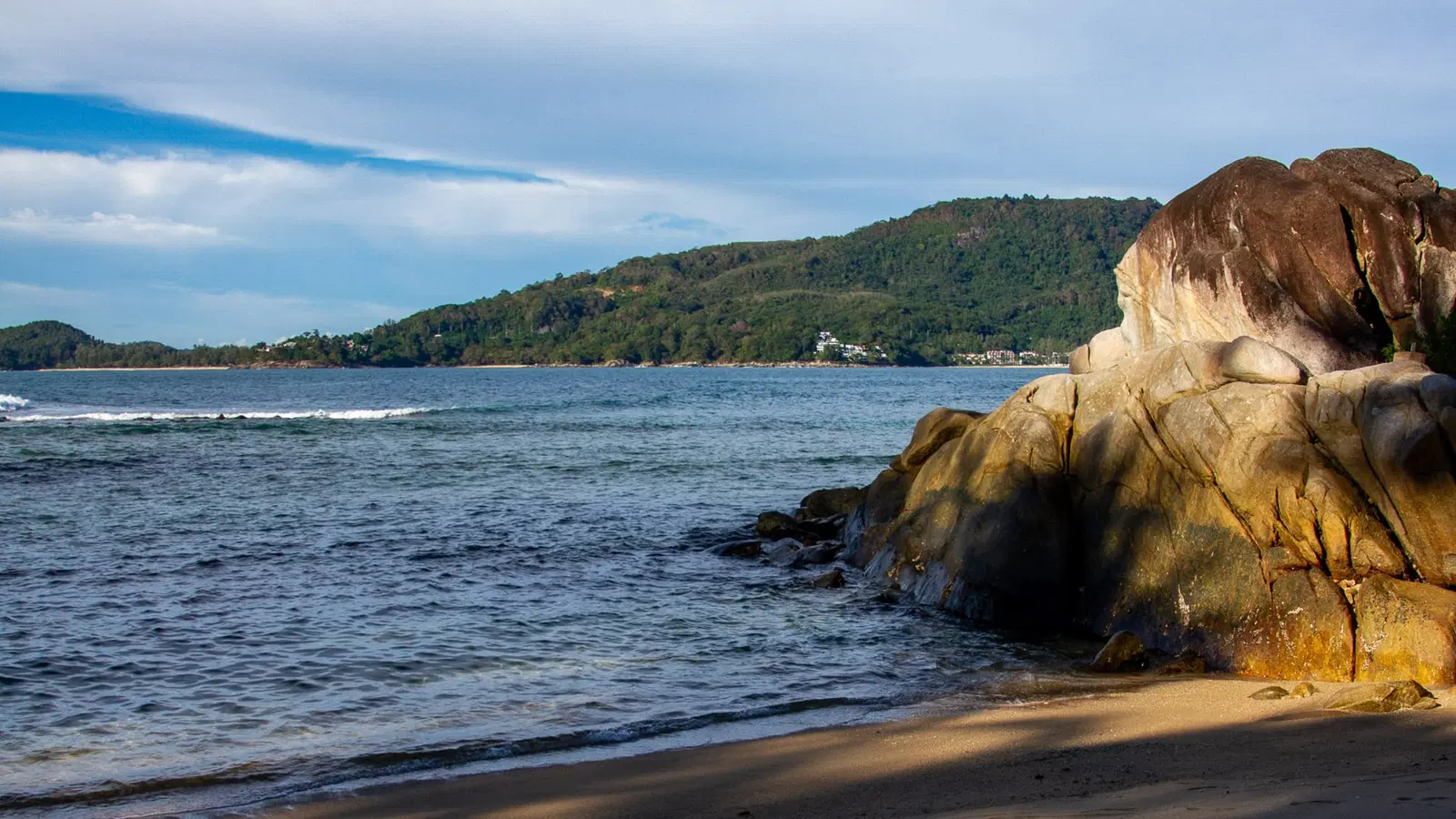
A wave washes onto the sandy edge of the beach beside a large rock, with hills in the distance.
Taking a dip at Hua depends on three things: the month, the tide and your footwear. Even then, it's better suited to snorkeling near the rocks than a proper swim.
The sea is calmest on this coast from November to February. The dry season lasts through April, while the water at neighboring Kamala is considered calm from December to May. From May to October, the sea along the Andaman coast is rough.

Rocky shallows with patches of sand and tree shade, looking across the bay.
Even in season, the seabed is an obstacle: rocks lie near shore, and at low tide the water recedes far enough that you have to walk over them to reach deeper water. Come at high tide with water shoes, a mask and a snorkel. You can swim near the rocks and see coral, though there aren't many fish.
On Phuket beaches with lifeguards, including nearby Kamala, red flags mark areas where rip currents are likely and swimming is unsafe. During the monsoon, strong waves add to the currents at Kamala.
Bring what you need

A bamboo shelter and a scooter in the shade of trees by the shore.
Hua has few facilities: tree shade, parking by the sand and a small cafe. Bring food, water and shoes for the rocks from your hotel or Kamala.
A small Thai restaurant in the parking lot serves food and drinks. It's best to bring water and a snack.
There are no restrooms or showers on the beach, and no rows of loungers, vendors or water sports rentals. Cars and scooters are parked under the trees right by the beach.
The turnoff is easy to miss
Hua is 2–2.5 km from Kamala along Millionaire's Mile, about 10 minutes by car. Look for two concrete posts by the road. Behind them, a narrow, newly paved concrete lane that looks like a jungle path descends to a shady parking area right by the beach, near Paresa Resort.
Most visitors drive a car or scooter all the way to the parking area. If you have to park higher up, the walk down may be difficult for young children and older visitors.
Kamala is 24–28 km from the airport, a 40–45 minute drive, and about 10 km from Patong. The Smart Bus from the airport passes through Kamala: the fare is ฿100 (≈ $3), and buses run every 30–60 minutes from 6:00 AM to 8:00 PM. It doesn't reach Hua, so you'll need a taxi or scooter for the last stretch.
Leaving Hua is harder than getting there: taxis are difficult to find at the beach, so having your own transport is most convenient. Scooter rental costs ฿300–350 (≈ $9–10) per day, and a short tuk-tuk ride costs ฿150–300 (≈ $4–9). If you take a taxi or tuk-tuk, arrange your return pickup time in advance.
Stay and dine in Kamala
There are no hotels right by Hua, and the only place to eat is the cafe in the parking lot. For accommodation and dinner, head to the slopes of Millionaire's Mile or Kamala. Find more nearby activities in Things to do in Phuket.
The hotels closest to the bay are expensive. Paresa Resort Phuket sits on a cliff 1.6 km from the beach, near the turnoff to Hua; its Talung Thai restaurant has sunset views. Keemala, 1.7 km away, offers forest villas above Kamala and the Mala restaurant. In Kamala itself, Hyatt Regency Phuket Resort is a large resort with the rooftop Latin American restaurant Casa Boho.
Staying in Kamala itself is simpler and cheaper. Benjamin Resort is by the beach, and Baan Chaba is another budget option.
In Kamala, Nanork Seafood is a simple local family restaurant overlooking the sea beneath coconut palms, serving tom yum, curry and pad Thai. Charoen Restaurant on Na Hat Road serves green curry and fried fish in tamarind sauce, while locals return time and again to PP&P for Thai food. For an evening by the water, Smile Bar and Lillo Island are right on the sand at Kamala.
Hua on the map: a bay west of Kamala
Hua and neighboring Rayee are two small bays on a narrow road beyond the southern end of Kamala. The turnoff is on the road above the bay; parking is below, by the sand.
| Place | Where from Hua | Straight line |
|---|---|---|
| Rayee Beach | to the east | 0.5 km |
| Samnaksong Charoentham Kamala | to the east | about 1.6 km |
| Paresa Resort Phuket | to the south | about 1.6 km |
| Keemala | to the east-southeast | about 1.7 km |
| Kamala, beach center | to the east | about 2.1 km |
| Yae and Nakalay Beaches | to the south | 2.4–2.6 km |
| Laem Sing | to the northeast | about 2.7 km |
Compare Hua with nearby beaches on the Phuket Beaches page, where you'll also find a map and curated lists.
Praised for peace, criticized for the seabed
Visitors praise the seclusion, quiet, views and fishing boats. They like being able to drive a car or scooter to the beach and park in the shade, with no vendors or rentals around.

Complaints include the rocky seabed, low tides, dirty water and lack of showers and restrooms. Visitors also say the turnoff is easy to miss.
Is Hua suitable for families with children?
With reservations. Rocks and low tides make swimming difficult for children, there are no lifeguards, and the sea is rough from May to October. In season, come at high tide and bring water shoes and a mask for the kids: fish and coral can be seen in the shallows near the rocks. If you can't park right by the beach, the walk down may tire young children.
Do I need to cover up?
Not on the beach. A dress code applies only at Samnaksong Charoentham Kamala on Na Hat Road, 1.6 km away as the crow flies. The temple was rebuilt after the 2004 tsunami, and admission is free. Cover your knees and shoulders; morning or late afternoon is the best time to visit.