


Koh Sukorn
Koh Sukorn lies three kilometers off the Trang coast, a 15–30 minute boat ride away. The island has stilt-house villages, rubber plantations, rice and watermelon fields, and buffalo that enter the sea during the dry season. Its beaches have dark sand and shallow water, with no reefs: come for village life rather than snorkeling.
About the island
Sukorn is the second-largest island off Trang after Koh Libong, covering about 12 km² according to the map. It lies parallel to the mainland, three kilometers offshore. The island forms one subdistrict of Palian, with four villages: Baan Saimai by the main pier, Baan Laem, Baan Thung, and Baan Hat Sai Thong. In 2016, it had about 2,500 residents, over 90% of them Muslim.
“Sukorn” means “pig” in Thai, although there are no pigs on this Muslim island. In one local legend about a son who disowned his parents, roast pork thrown into the sea became Sukorn, while a wrecked junk became neighboring Koh Petra.

A stilt house with a veranda in an island village
Stilt houses line the concrete road, with rubber groves, rice paddies, and watermelon fields behind them. There are few cars; people get around by bicycle, scooter, and saleng, a motorcycle with a sidecar. Three small resorts stand on the west coast.
Getting there
Mainland pier: Boats to Sukorn leave from Laem Tase, also known as Baan Tase, in Hat Samran district. There are two piers, old and new, 400 m apart. The pier is 40–60 km from Trang town, about an hour by car. Parking costs ฿60 (≈ $2) per day for a car and ฿30–40 (≈ $1) for a motorcycle.

Baan Saimai Pier, where boats arrive from Laem Tase
Boat: Longtails cross the channel in 15–30 minutes and dock at Baan Saimai Pier. There is no timetable: local boats leave during the day when enough passengers have gathered, subject to sea conditions. In 2020–2026, a seat on a shared boat cost ฿30–50 (≈ $1), a whole boat trip cost ฿300 (≈ $9), and a longtail for a group of up to 10 cost ฿700 (≈ $21).
From Trang without a car: Combined van and boat tickets are sold at Trang railway station and travel agencies.


Beaches and sea

Sukorn's sand is dark gray or brown. The water is shallow near shore, with rocks and mud farther out, and it is not turquoise. There are no colorful reefs, and snorkeling is limited. The shallows are calm for children.
Hat Lo Yai: A stretch of brown sand about 500 m long in the southwest. Resorts line the beach, and it is the only one on the island where swimming is possible at any tide.
Watermelon Beach: On the south coast near Baan Laem and Baan Thung. Watermelons are grown on the beach in December and January, and buffalo enter the sea along it during the dry season. The northeast shore near Baan Saimai is muddy and covered with mangroves.
Around the island
A concrete road of about 17 km loops around the island and is the main route for a day out. Resorts rent bicycles and scooters; in 2020, bicycles cost ฿100 (≈ $3) a day and scooters ฿300 (≈ $9). Without your own transport, you can take a saleng tour of the island: a 2.5–3 hour tour costs about ฿400 (≈ $12).
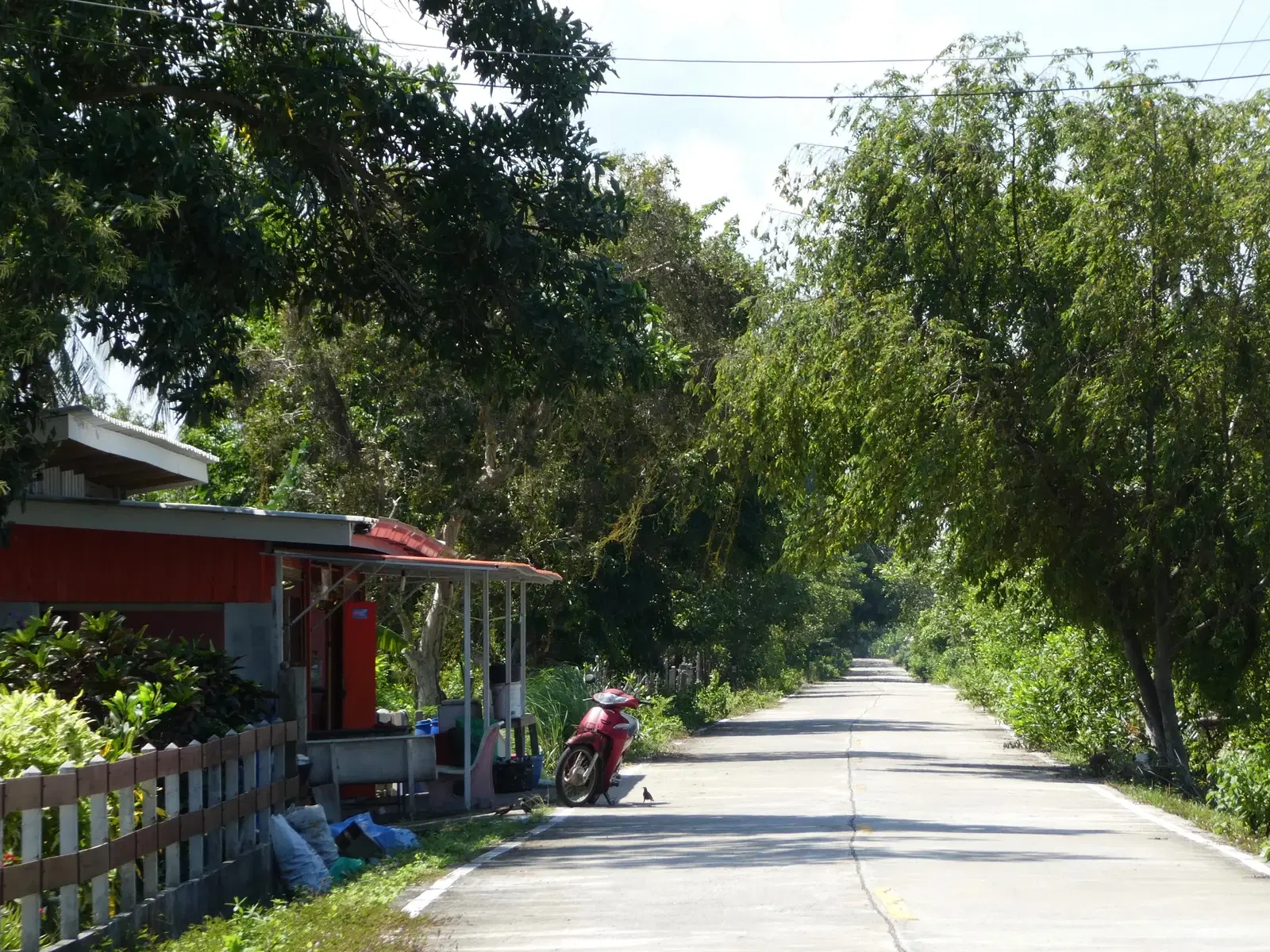
A concrete road along the village, part of the island loop
Buffalo: The island has about 300 buffalo in five herds, the only place of its kind in Trang. In the dry season after the harvest, the herds enter the sea along Watermelon Beach twice a day. In 2019–2020, this happened around 5:30 a.m. and 6 p.m.
Watermelons: Fields cover about 50 hectares and were farmed by 83 growers in 2024. There are three harvests: along field boundaries in November–December, on the beach in December–January, and in rice paddies in February–April. Since 2025, “Koh Sukorn watermelon” has been a Trang geographical indication.

A rubber sheet being pressed through rollers
Along the way: Rubber is tapped on plantations at dawn, then pressed into sheets through rollers. There is a viewpoint in the north and a batik workshop in the village.
Stays, food, and money

The edge of Hat Lo Yai beach, with limestone islands in the distance
The island has three resorts, all on the west coast: Sukorn Andaman Beach Resort, Yataa, and Sukorn Cabana Resort. In 2020, rooms cost ฿800–2,800 (≈ $24–83), from ฿800 (≈ $24) for a fan room to ฿1,400–2,800 (≈ $41–83) at Yataa, the only resort with a pool. Guesthouse rooms are available in Baan Saimai. Some accommodations close from May through October.
In 2020, all three resorts had Wi-Fi and mobile coverage was available across the island.
Food is halal, with no pork. Resorts serve fish and seafood; Baan Saimai has small eateries serving curry, noodles, and grilled chicken with sticky rice, while Baan Thung has a market. Blue crab is among the local catch.
When to go
The dry season runs from November through April, peaking in January and February. Thai visitor numbers are highest at New Year and Songkran in mid-April. The monsoon runs from May through late October, when many resorts close and few visitors come.
Time your trip around island life. Rice is harvested in late November and early December, beach-grown watermelons ripen in December–January, and field-grown melons from February through April. Buffalo enter the sea during the hot months after harvest. The island celebrates New Year at the turn of December and January, and a watermelon festival takes place in the south in early January.
Nearby national park islands
Sukorn is not part of Mu Ko Petra National Park, and there is no fee to enter the island. The park includes nearby Koh Petra, Lao Liang, and Beng, also known as Takieng. In 2020, a boat from Sukorn to these islands cost about ฿3,000 (≈ $89) per boat.
The park charges an entrance fee: since 2022, foreign adults have paid ฿100 (≈ $3) and children ฿50 (≈ $1).
Places and map
The map shows Baan Saimai Pier, where boats arrive, and Hat Lo Yai beach with its resorts.